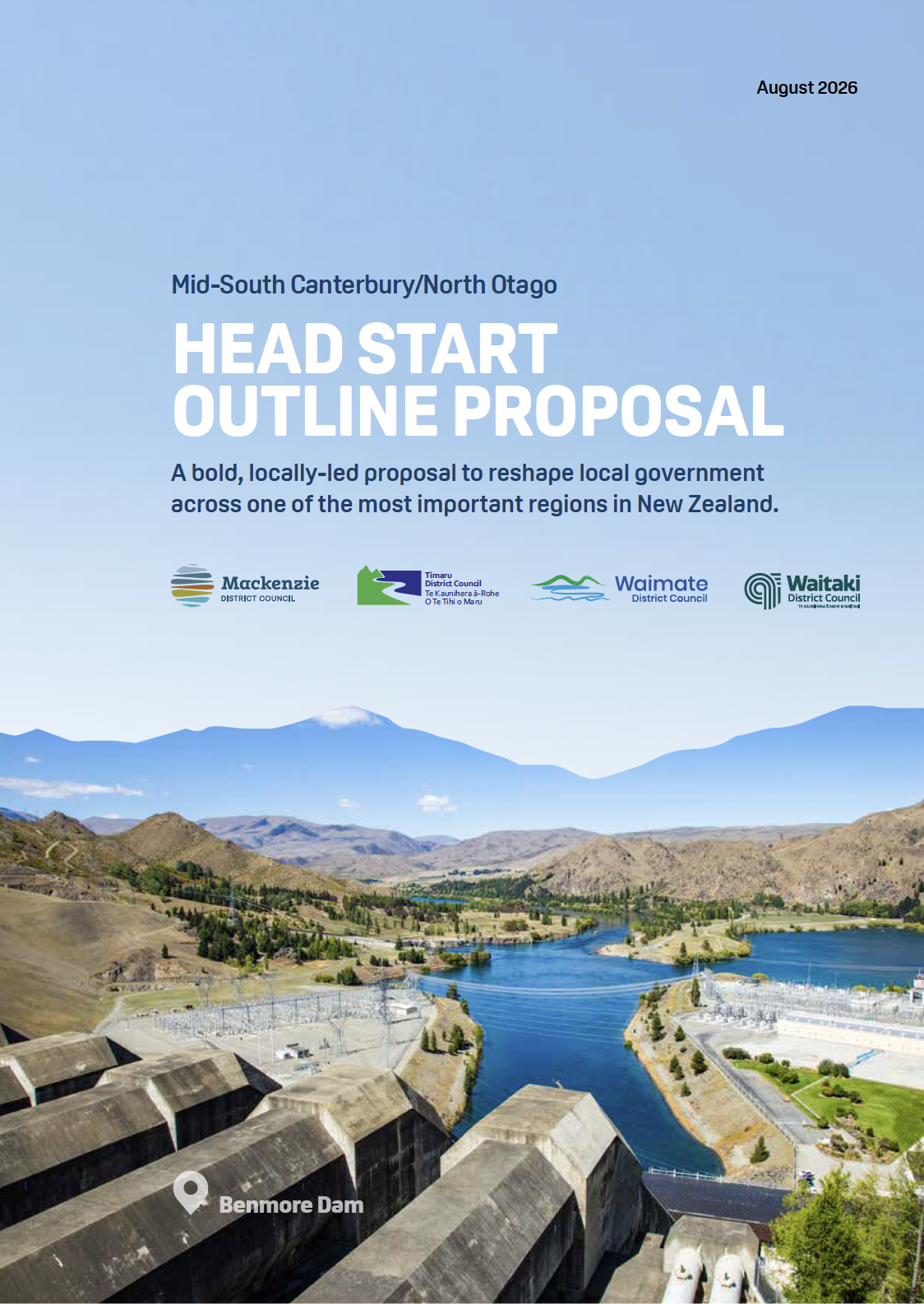
Local Government Reform - Head Start
Group of people silhouetted against a bright hazy sky.

This consultation is now closed.

UPDATES will be added to the News Feed at the bottom of this page.

The Proposal Document is available from the column to the right.

The Government is proposing the biggest shakeup to the way local government services are delivered across New Zealand since 1989.

Councils across the motu have been invited to put forward proposals for new unitary authorities — councils that would combine both district council and regional council responsibilities into one organisation.

Your council now needs to decide whether to submit an outline proposal to the Ministry of Cities, Environment, Regions and Transport by 9 August 2026.

Why, What & When?

Why is this happening?

New Zealand currently has separate district/city councils and regional councils in many parts of the country. District councils are responsible for local services such as roads, community facilities, libraries, parks, cemeteries and local planning and building consents.

Regional councils are responsible for functions including freshwater management, flood protection, environmental monitoring, biosecurity, public transport, regional transport planning, and coastal management.

The Government says it wants a simpler system, with larger unitary councils that do all these things while
ensuring they:

  • support the new planning system;
  • simplify local governance;
  • create economies of scale;
  • maintain strong local voice; and
  • can be realistically delivered in time for the 2028 local elections.

What is a unitary council?

A unitary council is a single council that carries out both:

  • the local functions currently carried out by district councils; and
  • the regional functions currently carried out by regional councils.

This means one organisation is responsible for local roads, parks, libraries, community facilities, district planning, environmental regulation, river and catchment management, flood protection, regional transport planning, and other regional functions. It
could also involve agreements to share the delivery of some services with other councils (but not the decision making).

A unitary council would not necessarily mean that every decision is made centrally. Any proposal would need to explain how local communities would continue to be represented and heard. Options could include wards, community boards, local committees,
local service centres, or other arrangements designed to maintain local voice.

Why was the timeframe so short?

The Government has set a deadline of 9 August 2026 for Head Start outline proposals. This means we do not have enough time to run the type of full consultation process normally expected for a decision of this scale.

We are therefore running a shorter, focused consultation process to help inform your local Council’s decision before it considers whether to submit an outline proposal. Although the timeframe is short, this is an important decision so it's important that you have your say.

CONSULTATION - We Asked:

Do you support Councils putting forward a locally led Head Start outline proposal, and if so, which broad direction do you prefer?

Council sought feedback on the following broad options A-E.

Note that all maps are indicative only and do not reflect what the final boundaries will look like. Information is sourced from publicly available sources.

Catchments vs territorial boundaries?

Should the new council follow existing council boundaries, or should it include whole river catchments where that makes environmental and flood-management sense? We’ve highlighted the approximate expanded areas on the maps in green.

For more information about each of the options click the links in the sidebar to the right.

  • Option A: A South Canterbury Unitary Council based on either territorial or river catchment boundaries
  • Option B: A Mid-South Canterbury Unitary Council based on either territorial or river catchment boundaries
  • Option C: A Mid-South Canterbury & North Otago Unitary Council based on either territorial or river catchment boundaries.
  • Option D: Do not submit a Head Start proposal and enter the backstop process.
  • Option E: Other option - you may prefer another arrangement.

This consultation is now closed.

UPDATES will be added to the News Feed at the bottom of this page.

The Proposal Document is available from the column to the right.

The Government is proposing the biggest shakeup to the way local government services are delivered across New Zealand since 1989.

Councils across the motu have been invited to put forward proposals for new unitary authorities — councils that would combine both district council and regional council responsibilities into one organisation.

Your council now needs to decide whether to submit an outline proposal to the Ministry of Cities, Environment, Regions and Transport by 9 August 2026.

Why, What & When?

Why is this happening?

New Zealand currently has separate district/city councils and regional councils in many parts of the country. District councils are responsible for local services such as roads, community facilities, libraries, parks, cemeteries and local planning and building consents.

Regional councils are responsible for functions including freshwater management, flood protection, environmental monitoring, biosecurity, public transport, regional transport planning, and coastal management.

The Government says it wants a simpler system, with larger unitary councils that do all these things while
ensuring they:

  • support the new planning system;
  • simplify local governance;
  • create economies of scale;
  • maintain strong local voice; and
  • can be realistically delivered in time for the 2028 local elections.

What is a unitary council?

A unitary council is a single council that carries out both:

  • the local functions currently carried out by district councils; and
  • the regional functions currently carried out by regional councils.

This means one organisation is responsible for local roads, parks, libraries, community facilities, district planning, environmental regulation, river and catchment management, flood protection, regional transport planning, and other regional functions. It
could also involve agreements to share the delivery of some services with other councils (but not the decision making).

A unitary council would not necessarily mean that every decision is made centrally. Any proposal would need to explain how local communities would continue to be represented and heard. Options could include wards, community boards, local committees,
local service centres, or other arrangements designed to maintain local voice.

Why was the timeframe so short?

The Government has set a deadline of 9 August 2026 for Head Start outline proposals. This means we do not have enough time to run the type of full consultation process normally expected for a decision of this scale.

We are therefore running a shorter, focused consultation process to help inform your local Council’s decision before it considers whether to submit an outline proposal. Although the timeframe is short, this is an important decision so it's important that you have your say.

CONSULTATION - We Asked:

Do you support Councils putting forward a locally led Head Start outline proposal, and if so, which broad direction do you prefer?

Council sought feedback on the following broad options A-E.

Note that all maps are indicative only and do not reflect what the final boundaries will look like. Information is sourced from publicly available sources.

Catchments vs territorial boundaries?

Should the new council follow existing council boundaries, or should it include whole river catchments where that makes environmental and flood-management sense? We’ve highlighted the approximate expanded areas on the maps in green.

For more information about each of the options click the links in the sidebar to the right.

  • Option A: A South Canterbury Unitary Council based on either territorial or river catchment boundaries
  • Option B: A Mid-South Canterbury Unitary Council based on either territorial or river catchment boundaries
  • Option C: A Mid-South Canterbury & North Otago Unitary Council based on either territorial or river catchment boundaries.
  • Option D: Do not submit a Head Start proposal and enter the backstop process.
  • Option E: Other option - you may prefer another arrangement.
  • Joint Council Media Release

    supporting image

    Councils unite behind Head Start proposal to reshape local government

    The mayors of the Timaru, Mackenzie, Waimate and Waitaki districts have jointly lodged an ambitious proposal to the Government under the Head Start programme.

    The plan, submitted to the Ministry of Cities Environment Regions and Transport on Sunday, proposes to create a single, stronger unitary authority across one of New Zealand's most economically significant regions.

    The proposal is the product of months of intensive work, honest debate and close collaboration between the partner councils, who share strong communities of interest across their economies, river catchments and outlook.

    The new region takes in the five districts of Waitaki, Waimate, Mackenzie, Timaru and Ashburton. It stretches from Aoraki/Mount Cook, the nation's highest peak, down through the region's mighty braided rivers to the Pacific coast.

    The mayors describe the region as a genuine powerhouse for the country – home to the Waitaki Valley hydro schemes that help power the North Island through the HVDC link, some of New Zealand's most productive agricultural land and food processing industries, and internationally renowned tourism destinations.

    Timaru District Mayor Nigel Bowen said the proposal reflected a shared, long-term vision rather than simply a redrawing of boundaries.

    "This has been a genuine team effort, and I'm proud of what our four councils have achieved together in a very short space of time," Mayor Bowen said.

    "We've chosen to take this opportunity to design a future council that will work for all our communities. This region powers New Zealand in the most literal sense, and this proposal is about making sure our local government is as capable and ambitious as the place it serves."

    Mackenzie District Mayor Scott Aronsen said the collaboration had been constructive and forward-looking throughout.

    "We've had open, honest conversations around the table, and that's exactly what a decision of this scale deserves," Mayor Aronsen said.

    "For our smaller and rural communities, this is about securing better services, stronger representation and real resilience for the future. Working together, we can achieve things none of us could deliver alone."

    Waimate District Mayor Craig Rowley said the process had been about keeping options open while doing the hard work properly.

    "There's been a huge amount of effort go into getting us to this point, and I want to acknowledge everyone involved," Mayor Rowley said.

    "This proposal keeps our district's voice at the heart of any future arrangement. It's practical, it's ambitious, and it makes sure smaller communities like ours are heard every step of the way."

    Waitaki District Mayor Mel Tavendale said the partnership recognised the deep connections across the wider region.

    "Our communities are linked by our rivers, our economy and our way of life, and this proposal reflects that reality," Mayor Tavendale said.

    "We've listened carefully to our communities throughout, and I'm pleased we can put forward something genuinely locally led. This is a once-in-a-generation opportunity to build something better together."

    The partner councils have proposed to include the Ashburton District in the final proposal, recognising that a larger footprint could offer greater scale, a broader rating base and stronger regional capability.

    The mayors say the proposal offers central government a single, capable regional partner for infrastructure investment, transport, and environmental management across a nationally important part of the South Island.
    Councils unite behind Head Start proposal to reshape local government

    The mayors of the Timaru, Mackenzie, Waimate and Waitaki districts have jointly lodged an ambitious proposal to the Government under the Head Start programme.

    The plan, submitted to the Ministry of Cities Environment Regions and Transport on Sunday, proposes to create a single, stronger unitary authority across one of New Zealand's most economically significant regions.

    The proposal is the product of months of intensive work, honest debate and close collaboration between the partner councils, who share strong communities of interest across their economies, river catchments and outlook.

    The new region takes in the five districts of Waitaki, Waimate, Mackenzie, Timaru and Ashburton. It stretches from Aoraki/Mount Cook, the nation's highest peak, down through the region's mighty braided rivers to the Pacific coast.

    The mayors describe the region as a genuine powerhouse for the country – home to the Waitaki Valley hydro schemes that help power the North Island through the HVDC link, some of New Zealand's most productive agricultural land and food processing industries, and internationally renowned tourism destinations.

    Timaru District Mayor Nigel Bowen said the proposal reflected a shared, long-term vision rather than simply a redrawing of boundaries.

    "This has been a genuine team effort, and I'm proud of what our four councils have achieved together in a very short space of time," Mayor Bowen said.

    "We've chosen to take this opportunity to design a future council that will work for all our communities. This region powers New Zealand in the most literal sense, and this proposal is about making sure our local government is as capable and ambitious as the place it serves."

    Mackenzie District Mayor Scott Aronsen said the collaboration had been constructive and forward-looking throughout.

    "We've had open, honest conversations around the table, and that's exactly what a decision of this scale deserves," Mayor Aronsen said.

    "For our smaller and rural communities, this is about securing better services, stronger representation and real resilience for the future. Working together, we can achieve things none of us could deliver alone."

    Waimate District Mayor Craig Rowley said the process had been about keeping options open while doing the hard work properly.

    "There's been a huge amount of effort go into getting us to this point, and I want to acknowledge everyone involved," Mayor Rowley said.

    "This proposal keeps our district's voice at the heart of any future arrangement. It's practical, it's ambitious, and it makes sure smaller communities like ours are heard every step of the way."

    Waitaki District Mayor Mel Tavendale said the partnership recognised the deep connections across the wider region.

    "Our communities are linked by our rivers, our economy and our way of life, and this proposal reflects that reality," Mayor Tavendale said.

    "We've listened carefully to our communities throughout, and I'm pleased we can put forward something genuinely locally led. This is a once-in-a-generation opportunity to build something better together."

    The partner councils have proposed to include the Ashburton District in the final proposal, recognising that a larger footprint could offer greater scale, a broader rating base and stronger regional capability.

    The mayors say the proposal offers central government a single, capable regional partner for infrastructure investment, transport, and environmental management across a nationally important part of the South Island.

  • UPDATE 31 July 2026

    On Wednesday this week (29 July) Mackenzie’s Councillors and Chief Executive met with elected members, mayors and chief executives from Ashburton, Timaru, Waimate and Waitaki District Councils at Fraser Park in Timaru for a facilitated discussion on options for a potential joint Head Start proposal and opportunities to strengthen collaboration across the region.

    The meeting brought together local government leaders to explore how councils could work together under the Government's Head Start pathway, which provides an opportunity for councils to develop locally-led proposals for future governance and service delivery arrangements.

    Discussions focused on identifying areas of shared interest, understanding the opportunities and challenges facing the region, and considering how councils might work collectively to develop a proposal that reflects local priorities and delivers long-term benefits for communities.

    Today, 31 July, at an Extraordinary Meeting, Mackenzie’s Councillors considered the feedback received from public consultation, including public meetings. The consultation had presented five options for local reorganization under the Head Start process.

    Council voted to proceed with Option C, a five-tier model made up of Mackenzie, Timaru, Waimate, Waitaki and Ashburton District Councils, as its preferred option, subject to Ashburton District Council's decision which is due to be made at their meeting on 5 August. This is in line with the majority of the submissions received from the public.

    Council’s second preference was for Option B, the four-tier model including Mackenzie, Timaru, Waimate and Waitaki District Councils.

    The final configuration will now depend on Ashburton District Council’s decision. Ashburton District Council will consider the matter at its meeting on 5 August and has indicated it will take the time needed to reach a decision before the 9 August deadline. Once that decision has been made, the Mayor and Chief Executive will work with the neighbouring councils to finalise the draft outline proposal for submission.

    On Wednesday this week (29 July) Mackenzie’s Councillors and Chief Executive met with elected members, mayors and chief executives from Ashburton, Timaru, Waimate and Waitaki District Councils at Fraser Park in Timaru for a facilitated discussion on options for a potential joint Head Start proposal and opportunities to strengthen collaboration across the region.

    The meeting brought together local government leaders to explore how councils could work together under the Government's Head Start pathway, which provides an opportunity for councils to develop locally-led proposals for future governance and service delivery arrangements.

    Discussions focused on identifying areas of shared interest, understanding the opportunities and challenges facing the region, and considering how councils might work collectively to develop a proposal that reflects local priorities and delivers long-term benefits for communities.

    Today, 31 July, at an Extraordinary Meeting, Mackenzie’s Councillors considered the feedback received from public consultation, including public meetings. The consultation had presented five options for local reorganization under the Head Start process.

    Council voted to proceed with Option C, a five-tier model made up of Mackenzie, Timaru, Waimate, Waitaki and Ashburton District Councils, as its preferred option, subject to Ashburton District Council's decision which is due to be made at their meeting on 5 August. This is in line with the majority of the submissions received from the public.

    Council’s second preference was for Option B, the four-tier model including Mackenzie, Timaru, Waimate and Waitaki District Councils.

    The final configuration will now depend on Ashburton District Council’s decision. Ashburton District Council will consider the matter at its meeting on 5 August and has indicated it will take the time needed to reach a decision before the 9 August deadline. Once that decision has been made, the Mayor and Chief Executive will work with the neighbouring councils to finalise the draft outline proposal for submission.

  • Thank you for coming to our public meetings

    Thank you to everyone who came to one of our public meetings this week.

    Many of you had good ideas, firm opinions, and were willing to engage with this piece of work that central government has asked us to do.

    Keep you eye out for the follow-up engagement when we'll be talking about the draft report.

    Don't forget to give us feedback, either through the form on this page, by email to feedback@mackenzie.govt.nz, or by dropping a note into one of our offices.

    Thank you to everyone who came to one of our public meetings this week.

    Many of you had good ideas, firm opinions, and were willing to engage with this piece of work that central government has asked us to do.

    Keep you eye out for the follow-up engagement when we'll be talking about the draft report.

    Don't forget to give us feedback, either through the form on this page, by email to feedback@mackenzie.govt.nz, or by dropping a note into one of our offices.

  • Public Meetings kick off this week

    Three public meetings will be held this week about the Head Start process.

    This is an opportunty it come along and listen to your Mayor and Councillors talking about the Simplifying Local Government work.

    It is also an opportunity to ask questions.

    • Twizel 15 June, 6-8pm Events Centre (either in the Community Lounge or in the Theatre depending on numbers)
    • Tekapo 17 June, 6-8 pm Community Hall, Tekapo
    • Fairlie 18 June, 6-8pm Community Centre (in the theatre).

    Three public meetings will be held this week about the Head Start process.

    This is an opportunty it come along and listen to your Mayor and Councillors talking about the Simplifying Local Government work.

    It is also an opportunity to ask questions.

    • Twizel 15 June, 6-8pm Events Centre (either in the Community Lounge or in the Theatre depending on numbers)
    • Tekapo 17 June, 6-8 pm Community Hall, Tekapo
    • Fairlie 18 June, 6-8pm Community Centre (in the theatre).
  • Mayoral Forum Meeting 12 June 2026

    A meeting of the Canterbury Mayors was held in Christchurch on Friday 12 June to continue discussions about Head Start.

    For details, contact Mayor Scott Aronsen. mayor@mackenzie.govt.nz

    A meeting of the Canterbury Mayors was held in Christchurch on Friday 12 June to continue discussions about Head Start.

    For details, contact Mayor Scott Aronsen. mayor@mackenzie.govt.nz

  • 4 June Head Start - MDC Updates

    Latest Update

    On Tuedsay 2 June at a council workshop Elected Members discussed the Head Start process with

    • Local representatives of Federated Farmers
    • Some local tourism operators

    Coming Up

    Public township meetings are planned for the week starting 15 June. Details on the MDC website and on this page.

    Latest Update

    On Tuedsay 2 June at a council workshop Elected Members discussed the Head Start process with

    • Local representatives of Federated Farmers
    • Some local tourism operators

    Coming Up

    Public township meetings are planned for the week starting 15 June. Details on the MDC website and on this page.

Page last updated: 10 Aug 2026, 01:19 PM